
Znode
Sana Commerce
A detailed comparison of Znode and Sana Commerce for manufacturers,
distributors, and wholesalers evaluating B2B ecommerce platforms.
Executive summary
Znode and Sana Commerce both support B2B ecommerce, but they offer different consequences in enterprise system architecture. Znode operates as an independent ecommerce platform that manages catalogs, pricing, and purchasing workflows directly in the platform while integrating with multiple ERPs and business systems. Sana Commerce extends the ERP into the buying experience and relies on the ERP to offer core commerce. This difference affects scalability, flexibility, and long-term operational ownership.
Znode establishes ecommerce as a business platform. Sana treats ecommerce as an ERP function.
What is Znode?
Znode is a distributed SaaS B2B ecommerce platform designed for manufacturers and distributors. It provides native support for complex pricing, account-based purchasing, multi-store management, and B2B2X operations. The platform operates independently of retail architecture and integrates with ERP, CRM, PIM, and other operational systems through its API-first architecture and Commerce Connector.
What is Sana Commerce?
Sana Commerce is a B2B ecommerce platform that connects closely to ERP systems and uses the ERP to manage pricing, inventory visibility, and purchasing behavior. The storefront extends ERP processes into ecommerce and relies on ERP configuration to control core commerce functionality.
Znode is built for B2B complexity and scale
Znode is built specifically for B2B ecommerce. It manages large catalogs, account hierarchies, contract pricing, and purchasing workflows natively in the platform. Commerce functionality does not depend on the ERP. Pricing, approvals, RFQs, and role-based purchasing rules operate directly in the platform.
Sana Commerce relies on the ERP to control core buying and pricing behavior. As product counts and customer rules grow, performance and flexibility depend on ERP capacity. Znode supports large SKU counts and complex catalogs without ERP load or configuration.
Znode gives organizations control over commerce. Sana makes commerce dependent on the ERP.

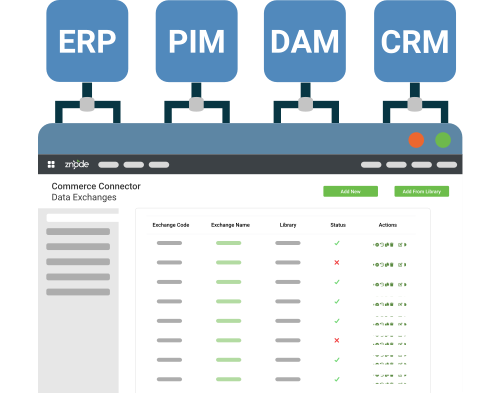
Znode provides ERP flexibility
Znode is built to integrate with ERPs, PIMs, CRMs, and other business systems. The platform includes the Commerce Connector for managing integrations and an API- first architecture with more than 1,000 REST API endpoints. It connects to multiple ERPs and business systems such as content management, product information management, order management, and more. Organizations can add or replace systems without rebuilding ecommerce operations. Commerce remains the central platform while operational systems evolve.
Sana Commerce is optimized primarily for Microsoft Dynamics and SAP environments. Other ERP integrations are limited and often require additional work or licensing.
Znode integrates ecommerce with the business. Sana ties ecommerce to a single ERP.
Znode provides long-term platform stability and support
B2B ecommerce platforms support ordering, sales operations, and revenue workflows. The platform vendor becomes part of daily business operations, not just a software provider. Znode delivers North American sales and support coverage, enabling consistent communication, implementation alignment, and operational assistance. Organizations depend on predictable support for upgrades, integrations, and expansion into new channels. Consistent vendor coverage helps reduce operational disruption and long-term risk.
Commerce platforms with limited regional support coverage often require longer response cycles and additional coordination during complex implementations.
Znode provides a stable platform partnership for ongoing operations, not only initial deployment.

Comparing Znode and Sana Commerce
B2B Ecommerce Features
| Feature | Znode | Sana Commerce |
|---|---|---|
| Multi-Store | Yes, Native, Unlimited | Limited by License, ERP-Driven |
| Account-Based Catalogs | Yes, Native | Yes, ERP-Driven |
| Customer-Specific Pricing | Yes, Native | Yes, ERP-Driven |
| Customer-Specific Catalogs | Yes, Native | Yes, ERP-Driven |
| Tiered, Contract Pricing | Yes, Native | Limited, ERP-Driven |
| Account Management Roles & Permissions | Yes, Native | Limited, Flat-Role Based |
| Quotes, RFQs | Yes, Native | Yes, Native, ERP-Driven |
| Order Approval Workflows | Yes, Native | Very Limited and Restrictive |
| Reordering, Saved Carts, Quick Order | Yes, Native | Yes, Native |
| Sales Rep Impersonation & Tools | Yes, Native | Limited |
| Customer Portal | Yes, Native | Yes, Limited |
| Dealer & Distributor Enablement | Yes, Native | No |
| B2B2X Support | Yes, Native | No |
| Self Service Portal | Yes, Native | No |
| Dealer & Distributor Portal | Yes, Native | No |
| Sales Rep Portal | Yes, Native | Yes, Native |
Modern Commerce Capabilities
| Feature | Znode | Sana Commerce |
|---|---|---|
| CMS with Drop and Drag Page Builder | Yes, Native, Unlimited | No |
| Headless Front-End | Yes | No |
| Personalization | Yes, Native | Yes, Native |
| Multi-Language | Yes, Native | Yes, Native |
| Multi-Currency | Yes, Native | Yes, ERP-Driven |
| Language Translation | Yes, Native | No |
| Regional Content Personalization | Yes, Native | No |
| AI-Enabled MCP Server | Yes, Native | No |
| AI-Powered Site Search | Yes, Native | No |
| AI-Powered Search Engine Optimization | Yes, Native | No |
| Promotions | Yes, Native | Yes |
| BI Reporting | Yes, Native | No |
Architecture and Extensibility
| Feature | Znode | Sana Commerce |
|---|---|---|
| Headless | Yes | No |
| API-First | Yes, 2,500+ API Endpoints | Limited |
| Customization Layer via API | Yes, Limitless Extension Points | Yes, Restricted |
| Distributed SaaS | Yes | No |
| Upgrade Impact | Low | High |
| Native ERP Integrations | Yes, Commerce Connector | Yes |
| Integration Type | Real-Time + Batch | Real-Time + Batch |
| Third-Party System Integrations | Yes | Yes, Secondary Integrations |
| Integration Logging and Monitoring | Yes, Native | Yes, ERP-Driven or Custom |
Performance and Scalability
| Feature | Znode | Sana Commerce |
|---|---|---|
| Supports Large SKU Counts | Yes | No |
| Infrastructure Model | Distributed SaaS | SaaS |
| Global Deployment | Yes | Yes |
| Scalability | Unlimited | Limited, ERP-Driven |
B2B2C Capabilities
| Feature | Znode | Sana Commerce |
|---|---|---|
| Supports B2B2C | Yes, Native | No |
| Supports Multiple Catalogs per Store | Yes | No |
| Central Governance | Yes | No |
| White Label Sites and Microsites | Yes, Native | No |
When Znode is a better fit
Znode is typically selected by manufacturers and distributors with complex operations, evolving system environments, or long-term digital expansion plans.
Znode fits best when organizations need:
- Large or growing product catalogs that exceed ERP performance and data limits
- Customer specific pricing, contract pricing, or approval workflows
- Account hierarchies with multiple buyer roles and permissions
- Multi‑store support for multiple brands, business units, or customer experiences
- Expansion into new channels, brands, or regions without duplicating data or admin effort
- Integration with multiple ERPs and business systems
- Complex and flexible approval and purchasing workflows
- Separation between ecommerce operations and the ERP
- Expansion into new channels, brands, or regions
- B2B voucher or credit programs
When Sana Commerce may fit
Sana Commerce may align with organizations standardizing commerce entirely around a single ERP environment.
Sana Commerce may fit best when organizations have:
- A single ERP system intended to manage pricing and purchasing behavior
- Smaller product catalogs and relatively simple pricing structures
- Limited need for integrations outside the ERP
- Simple purchasing workflows and approval requirements
- No need for multi-brand or multi- storefront experiences
Znode vs Sana Commerce FAQs
Znode operates as an independent B2B ecommerce platform that manages catalogs, pricing, and purchasing workflows directly in ecommerce. Sana Commerce relies on the ERP to control core buying and pricing behavior. The primary difference is architecture. Znode separates commerce from operational systems, while Sana Commerce places commerce logic inside the ERP.
Sana Commerce is closely tied to the Dynamics 365 and SAP ERPs and uses it to manage key commerce functionality such as pricing, inventory visibility, and purchasing behavior. The storefront extends ERP processes into ecommerce rather than operating independently of the ERP.
Znode does not require a specific ERP. The platform integrates with multiple ERPs through its Commerce Connector and API first architecture. Organizations can connect existing ERP systems and continue to change operational systems over time without replacing the ecommerce platform.
Znode is designed to support large catalogs and complex B2B pricing structures directly in the ecommerce platform. Because core commerce behavior is not dependent on the ERP, catalog growth does not increase ERP processing load. Platforms that rely on the ERP for commerce behavior may encounter performance constraints as catalog complexity grows.
Znode can integrate with multiple ERPs and operational systems, including product information management, order management, and content management systems. The platform is designed to operate as the central commerce layer while operational systems exchange data through integrations.
Znode natively supports customer specific pricing, contract pricing, approval workflows, and account-based purchasing rules within the ecommerce platform. Sana Commerce typically manages pricing through ERP processes, which ties purchasing behavior to ERP configuration.
Considering Sana Commerce? Take a Tour of Znode to Experience the Difference.
Review your B2B requirements with the Znode team to determine the right fit. Request a demo.