
Znode
Salesforce B2B Commerce
A detailed comparison of Znode and Salesforce B2B Commerce for manufacturers and distributors
evaluating B2B ecommerce architecture, total cost of ownership, and long-term scalability.
Executive summary
Znode and Salesforce B2B Commerce both support digital commerce, but they operate from fundamentally different foundations. Znode is a distributed SaaS platform built specifically for B2B ecommerce. Complex pricing, account hierarchies, multi-store management, dealer enablement, and ERP integrations operate natively within a unified commerce architecture. Salesforce B2B Commerce extends ecommerce within a CRM-first ecosystem. Many advanced capabilities require CPQ, additional cloud products, and signifiacant customization. As functionality expands, licensing layers and administrative complexity can increase total cost of ownership.
The primary difference is platform focus and architectural ownership. Znode delivers purpose-built B2B commerce with predictable operational control. Salesforce embeds commerce within a broader enterprise CRM strategy.
What is Znode?
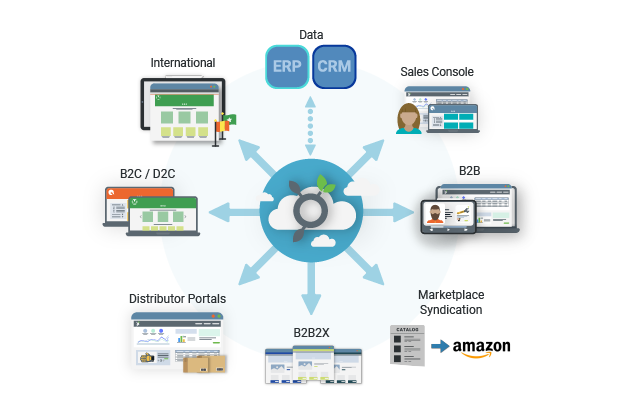
Znode is a distributed SaaS B2B ecommerce platform designed specifically for manufacturers and distributors. It provides native support for complex pricing, account hierarchies, multi-store management, dealer enablement, and B2B2X operations. The platform operates independently of CRM systems and integrates with ERP, CRM, PIM, and other operational software through its API-first architecture and Commerce Connector. Znode centralizes commerce within a unified platform built for scale.
What is Salesforce B2B Commerce?
Salesforce B2B Commerce is a commerce application built within the Salesforce ecosystem. It extends ecommerce functionality across Salesforce clouds, including Sales Cloud, Service Cloud, and often CPQ. Commerce operates as part of a broader CRM platform strategy. Organizations typically configure functionality across objects, clouds, and licensing layers to support complex B2B requirements.
Znode provides a unified B2B ecommerce platform with lower total cost of ownership
Znode is a purpose-built B2B ecommerce platform with native support for complex pricing, account hierarchies, multi-store management, and integrations. Core commerce functionality operates within a unified architecture, reducing customization and operational overhead.
Salesforce B2B Commerce operates within the broader Salesforce ecosystem and often requires configuration across multiple clouds and licenses. As functionality expands, administrative complexity and total cost of ownership typically increase.
Znode centralizes commerce with predictable ownership. Salesforce distributes commerce across an ecosystem that can raise long-term cost and complexity.
Znode was built around commerce strategy
Znode is an ecommerce-first company focused specifically on manufacturers and distributors. Product investment, roadmap priorities, and platform architecture are centered on solving complex B2B commerce requirements. Salesforce is a CRM-first organization. Its primary product strategy, revenue model, and innovation efforts focus on sales, service, and marketing clouds. Ecommerce operates as an extension of that ecosystem rather than as the core platform priority.
Znode builds its business around commerce. Salesforce extends commerce within a broader CRM strategy.
Znode delivers focused commerce partnership
Znode is a best-of-breed B2B ecommerce platform dedicated exclusively to ecommerce. Product strategy, support, and customer success efforts are aligned to helping manufacturers and distributors scale digital operations. Salesforce is a publicly traded enterprise software company with a broad portfolio across CRM, marketing, service, analytics, and AI. Commerce is one component of a much larger revenue model. Licensing structures, user-based pricing, and ecosystem dependencies can increase long-term investment as organizations expand.
Znode aligns cost and innovation to B2B commerce success. Salesforce aligns commerce within a broader enterprise software strategy.

Comparing Znode and Salesforce B2B Commerce
B2B Ecommerce Features
| Feature | Znode | Salesforce B2B Commerce |
|---|---|---|
| Multi-Store | Yes, Native, Unlimited | No, Customization |
| Account-Based Catalogs | Yes, Native | No, Customization |
| Customer-Specific Pricing | Yes, Native | Yes, Complex |
| Customer-Specific Catalogs | Yes, Native | No, Customization |
| Tiered, Contract Pricing | Yes, Native | No, Customization |
| Account Management Roles & Permissions | Yes, Native | Yes, Limited |
| Quotes, RFQs | Yes, Native | Yes, Requires CPQ |
| Order Approval Workflows | Yes, Native | Yes, Requires CPQ |
| Reordering, Saved Carts, Quick Order | Yes, Native | Yes, Native |
| Sales Rep Impersonation & Tools | Yes, Native | No, Customization |
| Customer Portal | Yes, Native | No, Customization |
| Dealer & Distributor Enablement | Yes, Native | No, Customization |
| B2B2X Support | Yes, Native | No |
| Self Service Portal | Yes, Native | No, Customization |
| Dealer & Distributor Portal | Yes, Native | No, Customization |
| Sales Rep Portal | Yes, Native | No, Customization |
Modern Commerce Capabilities
| Feature | Znode | Salesforce B2B Commerce |
|---|---|---|
| CMS with Drop and Drag Page Builder | Yes, Native, Unlimited | No, Extensions |
| Headless Front-End | Yes | Partial |
| Personalization | Yes, Native | Yes, Native |
| Multi-Language | Yes, Native | Yes, Native |
| Multi-Currency | Yes, Native | Yes, Native |
| Language Translation | Yes, Native | Yes |
| Regional Content Personalization | Yes, Native | Yes |
| AI-Enabled MCP Server | Yes, Native | Limited to Salesforce Products |
| AI-Powered Site Search | Yes, Native | Yes, Native |
| AI-Powered Search Engine Optimization | Yes, Native | Yes, Native |
| Promotions | Yes, Native | Yes, Native |
| BI Reporting | Yes, Native | Yes, Native |
Architecture and Extensibility
| Feature | Znode | Salesforce B2B Commerce |
|---|---|---|
| Headless | Yes | Partial |
| API-First | Yes, 2,500+ API Endpoints | Partial |
| Customization Layer via API | Yes, Limitless Extension Points | No |
| Distributed SaaS | Yes | No |
| Upgrade Impact | Low | High |
| Native ERP Integrations | Yes, Commerce Connector | No |
| Integration Type | Real-Time + Batch | No, Customization |
| Third-Party System Integrations | Yes | No, Customization |
| Integration Logging and Monitoring | Yes, Native | No |
Performance and Scalability
| Feature | Znode | Salesforce B2B Commerce |
|---|---|---|
| Supports Large SKU Counts | Yes | No |
| Infrastructure Model | Distributed SaaS | Salesforce Managed Cloud |
| Global Deployment | Yes | Yes |
| Scalability | Unlimited | Costly |
B2B2C Capabilities
| Feature | Znode | Salesforce B2B Commerce |
|---|---|---|
| Supports B2B2C | Yes, Native | No |
| Supports Multiple Catalogs per Store | Yes | No |
| Central Governance | Yes | No |
| White Label Sites and Microsites | Yes, Native | No |
When Znode is a better fit
Znode is commonly selected by manufacturers and distributors that require commerce to operate as an independent, scalable business platform.
Znode fits best when organizations need:
- Native B2B functionality
- Complex pricing, account hierarchies, and approval workflows
- Multi-store, dealer, distributor, or B2B2X support
- Structured ERP, CRM, and PIM integrations
- Distributed SaaS infrastructure with low upgrade impact
- Predictable total cost of ownership aligned directly to ecommerce
When Salesforce B2B Commerce may fit
Salesforce B2B Commerce may align with organizations that are deeply invested in the Salesforce ecosystem and prioritize CRM standardization.
Salesforce B2B Commerce may fit best when organizations have:
- Significant existing Salesforce Sales Cloud, Service Cloud, or CPQ investment
- Internal teams experienced in Salesforce configuration and administration
- A strategy centered on CRM workflows with ecommerce layered on top
- Willingness to manage cloud licensing structures and ecosystem dependencies
- Simpler B2B requirements supported within the Salesforce object model
Znode vs Salesforce B2B Commerce FAQs
Znode is a distributed SaaS platform built specifically for B2B ecommerce. Complex pricing, account hierarchies, multi-store management, and integrations operate natively within a unified commerce architecture.
Salesforce B2B Commerce operates within the Salesforce CRM ecosystem. Advanced capabilities often require CPQ, additional cloud products, or customization. The primary difference is architectural focus and total cost of ownership.
Salesforce B2B Commerce supports B2B transactions, but many advanced workflows such as tiered pricing, approval processes, and quoting often depend on CPQ or additional configuration.
Znode delivers complex B2B functionality natively within the ecommerce platform, reducing reliance on layered cloud products.
Znode does not require a specific CRM. The platform integrates with Salesforce and other CRM systems through its API-first architecture and Commerce Connector.
Organizations can connect existing systems without making CRM the architectural center of commerce operations.
Znode operates as distributed SaaS with infrastructure, upgrades, and core B2B functionality included as part of the platform.
Salesforce B2B Commerce often involves user-based licensing, multiple cloud products, and partner-led implementation. As organizations expand functionality across clouds, total cost of ownership can increase.
Znode is designed to support large catalogs, multi-store environments, and B2B2X operations within a distributed SaaS architecture.
Salesforce B2B Commerce scales within the Salesforce managed cloud, but scaling complex commerce workflows often requires additional licensing, customization, and ecosystem coordination.
Considering Salesforce B2B Commerce? Take a Tour of Znode to Experience the Difference.
Review your B2B requirements with the Znode team to determine the right fit. Request a demo.